The Complaints Choir: Response by Cole J. Alvis
Originally conceived by Finnish artists Tallervo Kalleinen and Oliver Kochta- Kalleinen, this community art project has seen successful compositions in Birmingham, Chicagoland, Tokyo and Jerusalem. Many of their performances have been documented and can be found online, as well as on the Harbourfront Centre website.
The pleasure of a good bellyache doesn’t discriminate as reflected by the diverse members of the Toronto Complaints Choir. Young and old, many communities were represented and while the group boasted more women then men, Bryce Kulak successfully maintains his duty as conductor while leading the vocal sections set aside for male voices.
Bringing the Complaints Choir into community spaces is at the heart of this project as it alters the way we encounter our city and the people in it. As the choir entered the Walker Court there was already an audience waiting but when they began singing people flooded the balconies to see what all the kvetching was about in the otherwise hushed gallery. The validation of hearing complaints experienced by many of the people in the audience set to a feel good tune is intoxicating and moved one excited listener to dance, clap and sing along. After it was all over, as I was waiting with the few crates needed to perform this show, an excited woman asked if I was involved with the choir. Thrilled this event was happening, she figured she had enough complaints she should run for Prime Minister. If the snow and the prospect of a spring election in Canada are getting you down there are two more chances to catch the Toronto Complaints Choir this week: Thursday from 6:30 – 8pm in the Distillery District and on Saturday from 3:15 - 3:45pm on the boardwalk just south of Harbourfront Centre. Read more!
La Voix Humaine: A Response by Hannah Cheesman
Van Hove is a director of mostly classical texts. But he interprets them through the contemporary and thus, we are granted greater access to this still quite timeless piece. Timeless because that pain of being abandoned by a lover is decisively identifiable. It would appear that that ineffable despair marking the end of love does not actually lie in language, or Cocteau’s text necessarily, but rather in those moments where Reijn doubles over in pain, silently mouthing screams she won’t give voice to.
The immediate interest I took in this piece even prior to watching, was how close the 1920’s actually are. This is not an Ibsen or a Strindberg classic. We are much closer to the post-war, pre-depression, and pre-war 1920s than much of the high-brow theatre we deem as classics. But unlike watching a Brecht (as the closest comparison I might draw), the emotional access we are immediately given due to the nature of the subject matter makes this echo of the past that much closer. I felt like I was looking at a palimpsest, and that the beating heart of this early 20th century piece was still quite audible. If I may be so bold: one can easily hear the ‘voice’ of the writer, his time, and even the actress he initially wrote this for. Because the text is monologue, I was impressed by van Hove’s work in sculpting and shaping its body. The writing itself did have, of course, an arc, a plunging into deeper despair from her initial and self-named bravery. But van Hove expertly (and with a mostly light touch) utilized all theatrical elements to create what I think could easily be likened to a sculpture or dance piece. It felt organically realized, from the simplicity of prop choices (a sweater, a cigarette, a phone, a shoe, and of course, the beautiful dress Reijn ends up in), to the changing light that gave dynamism to an otherwise still piece, and the music that acted to carve out scenes or ‘movements’. This spareness allowed the room necessary for this actress to feel, experience, and thus permit us to witness.
It’s my opinion, however, that the music was heavy-handed. The piece did not require it to indicate what the audience should feel where, nor did we necessarily require such a pointed nod to the present as “Single Ladies” by Beyonce. The (literal) window into someone’s life was entirely effective with only Reijn flitting across, around, and ultimately outside of her space. No manipulation of this kind was necessary.
Yet one cannot speak of a one-woman show without speaking of the one woman. Halina Reijn was committed, amazingly natural, engaging, and like van Hove, performed with a light touch. Both van Hove and Reijn worked in counter to the piece at times, putting laughter and levity to the heavy words she spoke. Again, I can’t help but draw comparisons to say a piece of music: deep bass, but shrill trumpet. Well thought-out, exacted, and inspired. Truly worth the price of admission. The only incongruity within her performance, I felt, was how ‘in her body’ she was. For a piece that for me was like sculpture, dance, or music, Reijn felt at times unusually disembodied. As much as her keening and writhing should speak volumes, there were flashes of something ungrounded, unmotivated. I wonder whether this was first-night-in-Canada jitters, or my expectation of dancer-like agility, given my likening this piece to other art forms. Still, I must emphasize how very minor this is, how very much one must search for criticism here.
I had a strange experience though, of floating in and out of the piece. Granted, the immediacy of her words were lost in the reading of subtitles, so this could very well have been reason enough for that. But disengaging was rather easy to do. I’ll return to the timelessness of the end of a relationship here: the same feelings, clothed in different words, make their appearance as always. And so, watching Reijn and hearing the cadence of her voice felt more revealing than the text itself. It makes sense, then, that one can step away and then return, without missing much content. In many ways this was a welcome relief, given how demanding one-person shows can be on an audience.
My only major criticism other than the musical choices was a somewhat pushed comedic sense. The Beyonce, the dog-miming, these moments felt like a laugh was anticipated, hoped-for, but chosen in a way that was strangely out of context or at least outside of the piece’s otherwise airtight realization. With such a delicate piece it is no wonder that I was so sensitive to minor gestures, which become so grand against the lean palette upon which this plays.
All this said, I do wonder about the play’s ultimate message. A woman is generous to the very end, giving of herself and her life entirely. The conclusion seems a kind of antiquated moment of French melodrama or romanticism, and here I smell a sort of outdated sketch of the female. I wonder whether this would have been written differently by Cocteau had he been alive today, or if perhaps this was the most active ending he could find. In any case, it left us with a beautiful image: Reijn in her indigo dress and heels, arms raised, the final sound she utters a sharp intake of breath. Read more!
Floating Critical Response by Alistair Newton
Currently making its third Canadian stop after being hosted by Vancouver’s Arts Club Theatre during the PuSh Festival and Intrepid Theatre in Victoria, Floating is performed by Dale-Jones and his co-creator Sioned Rowlands and has been, as we are told, years in the making. Prompted by the death of his beloved grandmother — portrayed in one of three charming performances by the admittedly untrained Rowlands — Dale-Jones’ theatrical alter-ego Hugh Hughes uses a tall tale about a Welsh island which separates from the mainland as a means to muse on community, family, and socio-cultural displacement. As the audience enters, Rowlands is seated onstage, quietly knitting, amidst a random assortment of projectors, miss-matched furniture and hand made charts and graphs. This folk-art aesthetic could be called ‘anti-theatre’ and it might be familiar to Toronto audiences from some of the work of companies Small Wooden Shoe and One Reed Theatre.
In this world, all of the pretenses of theatre are stripped away, the means of production are on display, and epic images are built from humble objects. Dale-Jones and Rowlands couldn’t be a more lovely pair and they wring a combination of pathos and bathos from Floating’s thin narrative frame which includes a crotchety school master’s scheme to sail an island, and a game of chicken with the Isle of White. The chatty nature of the performance and the childlike simplicity of the imagery conspires to breakdown the typical disconnect between performer and spectator; a sense of community or, as Hughes constantly reminds the us, ‘connection’ is the goal. The open heartedness of the performance is made even more impressive by the ease with which charming can mutate into smarmy when forced; there is none of that here.
For all of the high points of Floating’s breezy self-effacing charm, the problem of how to judge the images/choices/themes that don’t pay off remains. Kenneth Tynan, perhaps the twentieth century’s most astute theatre critic, turned to Schiller’s three point model for theatrical evaluation: what is the play trying to do, does it do it, and is it worth doing. If the goal is to create a sense of community by knocking down the fourth wall and breaking through audience expectations with tactics like passing props around the house as in an elementary school show-and-tell, appointing a front row patron as a kind of navigator, or encouraging patrons in the balcony to relocate to the main floor — leading to a hilarious interaction between the performers and three local indie theatre creators in attendance on opening night — then what is the value of picking apart the specific directorial choices? The third of Schiller’s three questions is easily answered in the affirmative but the second question, the question as to whether or not Floating fully satisfy its dramaturgical goals, is the more problematic of the triad.
In the slightly longwinded though often hysterical introduction, Dale-Jones outlines the themes he will explore in the piece. While Floating does contain some insights into the psychology of the Thatcher-era, the alienation from ideas of home and nationhood and the importance of the family, and in spite of the fact that the staged-lecture format allows for some interesting facts, ultimately I feel the piece lacks a fully satisfying emotional, political, or intellectual payoff. In spite of this fairly major quibble, in a cynical cultural moment ruled by banal hipster ‘authenticity’ by way of the warped equation of irony with nihilism, Floating’s earnestness and winsome passion are a welcomed antidote. As Ovid says in The Ars amatoria: ‘If you want to be loved, be lovable’.
Floating runs February 15-19, 2011 at Harbourfront Centre’s World Stage.
Read more!
Tender is the Show: Un peu de tendresse, bordel de merde! (A Little Tenderness, For Crying Out Loud!) at World Stage. Response by Vikki Anderson
Tendresse is part two of St-Pierre's Sociology trilogy – part one being La pornographie des âmes (Bare naked souls) seen here in 2008 at Harbourfront Centre’s World Stage. His latest work, Over My Dead Body, which premiered in Montreal in 2009, he examines mortality, primarily his own. St-Pierre was diagnosed with cystic fibrosis at seventeen, a multi-organ disease primarily affecting the lungs, which can cut life expectancy in half.
Often cited as the enfant terrible of contemporary dance, St-Pierre has enjoyed a somewhat meteoric rise to fame in the past decade with this triptych that examines contemporary utopias – self-worth, love and death – using transgressive imagery Part dance, part theatre, part happening, Tendresse unfolds from the minute you take your seat. Emerging from the crowd to take the stage, the dancers identify themselves then cause a humorous ruckus in the house. The onstage host, Sabrina, welcomes the audience and advises that there will be no fourth wall. When she asks, “Do you really want to see a show about tenderness?” the audience dutifully replies in the affirmative and she yells back at us, “Losers!” and follows up later with, “You would be so naïve to think you’re safe tonight”.
What evolves is a montage of vignettes and tableaux questioning, rather fearlessly, our suppositions about love and the human form. Deploying highly entertaining and humorous techniques (you might be lucky enough to have a naked man in your lap) contrasted with moments of great pain (watching dancers slap themselves until you want to go up and stop them) St-Pierre takes hold of your emotional centre and doesn’t let you go for 100 minutes.
The work is demanding of both the performers and the audience. It forces us to examine our innermost demons: lust, shame, weakness, regret and the gut-wrenching desire to be loved. It’s the kind of communal experience you can only have in the theatre. To be a part of it, to watch souls and bodies laid bare, to watch indignity and dignity run at each other, to bring your own catalogue of desires, base human needs and culpability along for the ride, is as exhilarating as it is life affirming. St-Pierre gives us hubris in it’s highest form; the gain without the pain.
In the final, breathtaking moments, our host admonishes us: “You’ve all been sitting there doing nothing for the last two hours and we’ve been doing everything. Do something for us now.” She instructs the audience to perform a sports arena-like wave that sets off a tsunami onstage where the literal and figurative cost of drowning becomes beautiful, savage, joyous and tender.
I can’t think of a more appropriate title for the work; tenderness is such a full word. It brings to mind everything from Otis Redding and General Public to the small, vulnerable moments of affection and devotion that fill our memories and consciousness. It evokes benevolence, kindness and generosity while also reminding us that once something becomes tender, it has the ability to torment and ache. St-Pierre’s affirmations are what we strive to find, in small measure, every day. To be offered a safe space, a temple of sorts, where we can observe, participate and above all, feel, is a genuine gift.
Vikki Anderson, a Toronto-based director, designer and producer, is the founder of DVxT Theatre Company. DVxT brings artists together to work on demanding texts with a focus on longer rehearsal time and an organic design process. www.dvxt.com Read more!
Questo Buio Feroce: A Response by Salvatore Antonio
Compagnia Pippo Delbono, is by virtue of its company members unforgettable to behold. In addition to professional performers, the troupe includes individuals from the fringes of society; there is the deaf-mute Bobò (institutionalized in a Naples psychiatric hospital for over forty years before being made a central component of Delbono’s work), Gianluca (a former elementary-school student of Delbono’s mother, who has Down’s Syndrome), former homeless people (including a schizophrenic discovered begging), street performers and musicians. (Bobò and Gianluca play two Harlequins in a stilted game of hide-and-seek that both filled and broke my heart simultaneously). Delbono himself performs with his motley crew of pros, amateurs, denizens, and the compromised. Together they have developed a physical and emotional vocabulary that is refreshing, if not jarring in it’s magical reality; the feelings emoted are raw, the movement and gesture–– sincere and unrefined. The mere presence of this collection of bodies in space, on a stage, reflects the lives they have lived before the Theatre. With this company, the storytellers are those we might usually step over on our way to the theatre. Those on the expertly-lit stage are the battle-blind, scarred, the pathetic–– and beautiful in their bare humanity.
Pippo Delbono, the frontman for this outfit, is most definitely a man of the theatre having earned his creative stripes through an inspiring life of study and performance. He trained with the Odin Theatre, worked with the late choreographic genius Pina Bausch in the Wuppentaler Tanztheatre, also with Iben Nagel Rasmussen’s Farfa Group in Denmark, and continues working along-side Argentina’s famed actor Pepe Robledo. He also spent time in India, China, and Bali studying cultural movement and dance-theatre. His physical presence on stage is that of a bear (with his paunch and scruffy beard), but his movement is full of the gentle grace and precision of a dove.
Questo Buio Feroce is a fierce dance of life, swirling around the open grave of the inevitable end... or is it the beginning? I got the sense this is what Delbono is exploring; his own relationship to his own mortality. To attempt to see death as a part of life, rather than a circling wolf. He vacillates on the subject; fearing, challenging, hiding, protesting, embracing, defying, enjoying... he never presents a clear blueprint for dying, but rather presents an honest and personal exploration–– with all its winding alleys, and grand vistas. The piece plays out on a stark white set, and begins with an unclothed figure lying in a fetal position wearing a white tribal mask that is primitive and naive in nature; he moves about the space with unaffected child-like articulation. Just as soon as I became accustomed to the innocence and simplicity, the voyage took its first sharp turn with the entrance of a nurse, and two orderlies in white Hazmat suits whose presence instantly transformed the space into something clinical and sterile, and our original masked character into something diseased, or detained.
Those in the audience looking for clear or congruent storytelling might find it easier to watch through squinting eyes, because this piece unfolds like a dream; images and sound only anchor the viewer in a ‘story’ for brief moments before any defined edges quickly disintegrate and morph. At certain points, a static figure on stage accompanied by a voiceover, conveys parts of a story. Other times several characters on stage moving in slow, deliberate choreography against a musical score reveals other parts, but even a character monologuing into a hand-held microphone, doesn’t necessarily point in any one direction. Over all I felt like I was witnessing a disjointed human experience suspended (sometimes literally) in an undefined reality. The one form of communication missing from the piece is dialogue between any characters on stage.
But as soon as Pippo Delbono himself, appears on stage, I got the feeling he was already mid-conversation with us: the audience. Even though he doesn’t utter a live (non-recorded) word until the end of the piece, surtitles spell out the narrative of his thoughts, as he breathes in concert with what we’re reading. What he’s visibly experiencing in front of us is deeply personal and unsparing, and in his face you can see unlabeled raw emotion and undeniable need, pass like dark clouds through him. We are his witness; we can confirm, we can judge, or we can join him in his quest. What is clear is that he is seeking clarification. And I realized as in life, sometimes all you can do as the witness, is stay present through the seeker’s ramblings. Rambling might be too dismissive a word in this case, because the offerings on stage are steeped in symbolism and distilled through traditions as ancient and far-flung as Japanese theatre, Greek drama and Christian miracle plays. The construct and execution of the performance seems heavily inspired by a fresh mix of Bausch, Pasolini and Fellini; part confessional, funeral and parade. Images of simple beauty and the grotesque intermingle as if fraternal twins.
Delbono’s exploration, although exhaustive, seems bridled–– there is no yelling, screaming, keening, no violence, or explosions in the piece. He has directed the piece in a manner that is quiet, suspended and sustained: lending a deliberately portentous, ceremonial tone to both the banal and the momentous vignettes that make up Questo Buio Feroce. I must be honest in saying that the spectacle tested my patience at certain junctures, as I struggled to find meaning in what I was watching, or searching for clear plot-points, or conversely, whenever I quickly figured out what the point of a scene was and wished for it the piece to move on. I recognize this battle between logic and surrender, was my own to wage as part of my experience. I then realized the piece was asking nothing of me, but only suggesting options and possibilities. Perhaps the battle between logic and surrender wasn’t too far from what I was witnessing on the stage?
In the end the show won me, as the funereal carnival (bookended by both ancient and innocent Harlequins) made it’s way back on stage, circling a stripped Delbono, who in his repetitive physical incantation, smiles a smile so real and warm for the first time in the piece, that we see an ecstatic peace we can only hope for. The whole experience ended up feeling like an invitation to face my own death, and find my own peace perhaps. I left the theatre feeling like I was slowly stepping out from a hallucination, not quite sure whether it was a dream or a nightmare. And more importantly, I wasn’t quite sure if I wanted to shake it off... completely.
Questo Buio Feroce is a bold and brave piece executed with an unapologetic voice. The company succeeds in effectively blurring the line between dance and theatre; the pedestrian bodies of these performers can sometimes communicate emotion and evoke real response, in a way that beautiful, chiseled dancer-physiques can sometimes obscure, or distract the viewer from.
There were moments and images that were captivating and haunting and exhilarating, but as I left the theatre, I wasn’t entirely sure the piece worked as a whole; maybe that’s because I felt stranded in someone else’s internal dreamscape of monsters-- both mythical and real. The piece itself offers this final bit of comfort and warning, “Parting, is all we can know of Heaven. Parting, is all we need to know of Hell.” If asked what the piece is ‘about’, my answer would be the same as if I were asked what death ‘is’; I’m not sure. In both cases however, the experience of questing for an answer can be rewarding in and of itself.
Read more!
Capturing the contrasts in PHOTOG, Review by Mariel Marshall
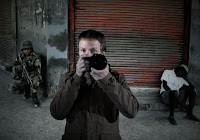
They say a picture is worth a thousand words. But in this day and age is a single photo enough to capture something as small as a moment or as vast as an entire war? Perhaps that is all it takes; one look to discard the complexities of a single still image: a child holding a gun, an orphaned Iraqi woman, or a half buried pile of civilian casualties. Presented by Vancouver based company Boca del Lupo, PHOTOG: an Imaginary Look at the Uncompromising Life of Thomas Smith, examines the controversial and provocative worlds of conflict journalism through the fragments of one man’s memory. In 2008 co-creator Jay Dodge interviewed four contemporary conflict photographers on camera in New York City. He weaves together their experiences, memories, and photographs into PHOTOG; a challenging piece that asks us to look closer at our complacent attitudes toward war, conflict and poverty.Urbanvessel Deconstructs Gender One Punch at a Time in Voice-Box, Review by Cara Spooner
I thought it very appropriate that the rehearsal space for the boxing opera Voice-Box was a children's ballet studio. I could only imagine that between Nutcracker rehearsals, girls in pink gauze may have peered in to see the fierce women of the urbanvessel collective boxing while singing about “slug fests” or doing push-ups. I wish I could have been there when those young individuals were struck by curiosity. I wish I could have asked them what they thought about seeing women box and if it made them feel tough or cool; if they felt taller or stronger, more empowered, or if it made them feel conflicted or confused or even scared. I would want to ask them why they felt the way they did and what they thought contributed to their reactions.
Originally commissioned through the Fresh Ground new works series, Voice-Box is the latest production by the Toronto-based collective being presented this week as part of World Stage at Harbourfront Centre. Singers/composers/improvisers/boxers Vilma Vitols, Neema Bickersteth, Christine Duncan, and Savoy Howe team up with Juliet Palmer, Julia Aplin, Anna Chatterton, Teresa Przybylski, and Kimberly Purtell to create a show which is part boxing match, part opera. The singers move between choreography, voice work, and boxing within a constructed boxing ring rather than a traditional stage. The piece is broken into four rounds and includes fractured narratives and story lines as well as real boxing.
I knew before arriving at the Voice-Box open rehearsal that the idea of gender portrayal is still something many people struggle with and that the show is an attempt to illustrate some layers of this complex notion. I've thought a lot about “toughness” and what it means to be “feminine” or “not feminine” and subsequently what it then means to be “masculine” or otherwise. In a way, I am amazed that we are still surprised by the supposed roles of men and women. Haven't we moved past classifying gender in such a narrow scope? Can't we forget about focusing on how these are women boxers/singers and just enjoy the extremely physical and emotional nature of these two forms together in space? Can't they exist as a group of highly trained individuals who have set out to explore something within the particular frame of this stage/ring?
But as much as I'd like that to be the case, it’s not possible. We can't ignore the fact that these deeply ingrained gender structures still exist or at the very least are transitioning out of an incredibly long-lived past history (which ultimately shadows the notion of contemporary women today). The entire piece is extremely self-aware of the gendered nature of the performers; in a big way, their gender is the point of the piece. The performers have tea parties, flirt, fight in tutus, skip rope, apply make-up black eyes, and perform slow motion boxing choreography. They sing and smile while portraying stereotypical feminine women as well as butch women or any classification in between. The tongue in cheek tone of the piece seems to slip to the side of humour and stylized suggestions of “real” boxing and “real” women.
But there were also moments when dipped into something deeper. I wanted to see the heartbreak and exhaustion of what I can only imagine would occur at a boxing match or training gym. I wanted to hear them sing and feel their (and my) guts vibrating. I wanted to hear their stories and to be held by the performance, drama, and spectacle that I knew these two forms are able to provide. I felt this urge inside of me to see them fight and sing and live while still being seen as “feminine” because I am under the impression that “feminine” or “masculine” are only things we each construct by simply being who we are and existing in the world. We each get to define what gender means for us.
The elemental similarities of spectacle, drama and skill found in the theatre and the sports ring were closer than I anticipated. We as audience members know our place in the theatre; we know our traditional role. We also know our role as a spectator when attending a sports game. I loved the conflict of these two roles (and their consequential social codes) being butted up against each other in Voice-Box. I loved that fight within myself when considering I know how I should behave.
I've heard about Savoy Howe's gym The Toronto News Girls and the incredible Shape Your Life boxing program for victims of abuse that is affiliated with it. I've heard about how this is one of the only women and trans friendly spaces for people to explore boxing and it makes me proud that this place exists in Toronto. It makes me proud that people like her are doing the work they do.
Read more!


